

Commercial building pressure washing has long relied on scaffolding, rope access and elevated work platforms to deliver quality results. These established approaches are essential for many projects, particularly those requiring detailed inspection, structural repairs or delicate surface treatment. However, drone pressure washing offers compelling advantages for specific applications.The question isn't about which method is better. It's about which approach best suits your building's unique requirements, operational constraints, and maintenance objectives. Let's explore how aerial pressure washing complements traditional methods and when it becomes the right choice for your property.
The operational advantages that matter
For facility managers juggling maintenance schedules, budget constraints and operational continuity, drone pressure washing addresses several persistent challenges that traditional methods can’t overcome:
Speed translates to less disruption
Commercial building pressure washing with drones can be done up to five times faster than conventional approaches. A building facade that would typically require days of scaffolding access can be cleaned in hours.
Access without the infrastructure overhead
Scaffolding takes time to erect and dismantle. Rope access demands specific anchor points and weather-dependent scheduling. Elevated work platforms need site logistics coordination and ground-level access. Drones eliminate these requirements entirely, accessing rooflines, architectural details and awkward angles without requiring the supporting infrastructure.
Safety improvements are measurable
Working at heights remains a leading cause of workplace fatality in Australia. Drone pressure washing eliminates workers' exposure to height. For property managers focused on workplace safety compliance and liability reduction, this matters.
Water efficiency supports sustainability goals
Australian commercial properties face increasing pressure to demonstrate environmental responsibility. Water conservation in commercial buildings has become a key performance indicator, with building owners expected to justify water usage against industry benchmarks.
Drone pressure-washing systems use high-flow, precision spraying to deliver water exactly where it's needed, reducing waste compared with traditional methods that often rely on broader coverage patterns. High-pressure water reduces the need for harsh chemicals, and when cleaning agents are required, eco-friendly solutions support green building certifications.
Precision cleaning adapts to different surfaces
Different facade materials respond differently to pressure washing. What works for concrete can damage render, and the pressure appropriate for brick may be too aggressive for painted surfaces. Traditional methods often force compromises, either undercleaning delicate areas or requiring providers to manually adjust pressure.
Drone systems allow operators to adjust pressure and flow rates in real time, calibrating cleaning intensity for each surface type without repositioning the equipment. This matters particularly for buildings with mixed materials or surfaces where inappropriate pressure could compromise weatherproofing or void warranties.
When drone pressure washing becomes the obvious choice
Certain building characteristics and operational requirements make drone cleaning not just advantageous but practically essential:
- Multi-storey commercial buildings where traditional access would require extensive scaffolding coordination benefit immediately from reduced project timelines and eliminated site disruption.
- Retirement living facilities where resident wellbeing depends on minimising construction activity find the speed and reduced footprint particularly valuable. No scaffolding blocking pathways, no restricted access to common areas, no extended noise and disruption affecting daily routines.
- Shopping centres that can't afford disruption to facade access during trading hours gain operational flexibility they've never had. Cleaning can be scheduled around peak periods without the logistical constraints imposed by scaffolding.
- Stadiums where regular event schedules mean tight maintenance windows. Large facades, grandstand structures, and hard-to-reach architectural features can be cleaned without ground-level equipment blocking entry points, ticketing areas or hospitality zones that need to stay accessible.
- Properties with complex access challenges, such as complex rooflines or limited ground access, often find that drone cleaning offers solutions where traditional methods pose genuine barriers. Buildings in tight urban locations, facilities bordering neighbouring properties or structures with protected architectural features, all benefit from access that doesn't rely on ground-level equipment placement or invasive anchor points.
- Buildings with a history of disruption, where previous cleaning projects generated tenant complaints, extended operational disruptions, or budget overruns, frequently reassess their maintenance approach after understanding what's now possible.
What this means for your property
Commercial property maintenance has always involved trade-offs among thoroughness and disruption, cost and timeline, and quality and operational impact. Drone technology doesn't eliminate these considerations, but it changes the equation significantly for commercial building pressure washing.
The advantages are measurable: faster project completion, eliminated height safety risks, reduced operational disruption, and improved water efficiency. For buildings where traditional cleaning methods have delayed necessary maintenance, where tenant complaints about disruption have become routine or where maintenance costs have limited cleaning frequency, aerial pressure washing addresses the constraints without compromising results.
The technology is available now. Facility managers are already using it to maintain building presentation without sacrificing operations, unlike traditional methods. Facades are being cleaned before prospective tenants tour. Buildings are being refreshed ahead of lease renewals. Common areas are being maintained without the prolonged disruption that generates complaints.
The question for property managers isn't whether drone cleaning will eventually become standard practice. It's whether your building's maintenance approach is keeping pace with what's already possible.
Take your building maintenance to new heights with drone‑powered washing that’s faster, safer and more sustainable.
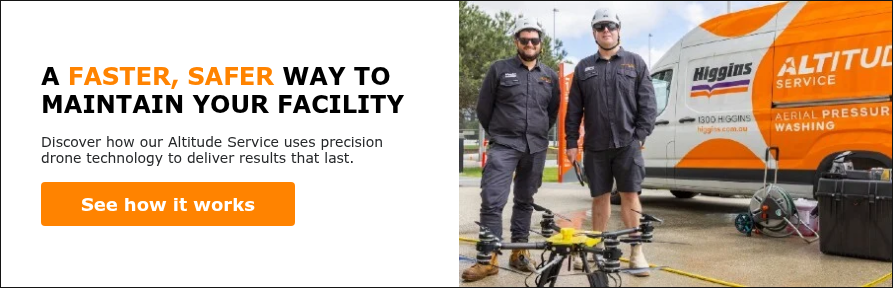
Higgins Coatings provides comprehensive building maintenance plans, commercial painting, and facade washing services across Australia. Our drone pressure washing service delivers superior cleaning results faster than traditional methods, with minimal disruption to building operations. With an ISO tri-certification in safety, quality, and the environment and almost 80 years of experience, Higgins understands what commercial property managers need. Contact us today to learn more about our building maintenance solutions.