

Facade access isn't one-size-fits-all. Your choice of method directly impacts project timeline, operational disruption, safety outcomes and budget.Scaffolding, rope access, elevated work platforms and aerial drone systems each excel in different scenarios. The key is matching the method to your building's characteristics and project requirements, not defaulting to the familiar or chasing the newest option.
Here's how each facade access method works, when it delivers best results, and how to choose the right approach for your project.
Your facade access options
Scaffolding
Scaffolding provides stable, comprehensive access through temporary frameworks erected around buildings. It provides a complete, fully operational platform suitable for heritage restoration, detailed repairs, and projects where contractors require consistent, stable access. Setup can take days, depending on your building's height and complexity. The platform supports multiple workers and equipment, making it ideal for coordinating multiple maintenance activities simultaneously.
Rope access
Rope access involves trained technicians working from ropes anchored to building structures. It offers flexibility and mobility without a ground-level footprint and is particularly effective for tall buildings in urban environments where scaffolding is impractical or cost-prohibitive. Setup is faster than scaffolding, but still requires inspecting anchor points and installing the safety system. Ideal for high-rise buildings, CBD towers, spot repairs, and projects in locations with limited ground access. Rope access technicians can reach virtually any building surface, making this method valuable for complex architectural features.
Elevated work platforms (EWPs)
EWPs provide mobile access via boom lifts, scissor lifts, and cherry pickers. They provide quick deployment for mid-rise buildings with straightforward access. Ground conditions and reach limitations determine suitability, making this method typically effective for buildings up to 20 metres in height. EWP services are best for shopping centres, industrial facilities, and commercial buildings where ground access permits equipment positioning. The mobility enables responsive repositioning, making EWPs efficient for cleaning, minor repairs, and maintenance work across accessible areas of the building.
Aerial drone washing
Aerial drone washing uses remotely operated drones with precision spraying equipment. Technicians operate from ground level with no exposure to working at heights. This makes it the fastest to deploy and complete of all methods. Optimal for routine cleaning when the primary objective is to restore the facade's appearance without concurrent repairs or detailed inspection. Particularly effective for glass curtain walls, modern commercial buildings, and properties where operational continuity is critical. The technology navigates complex building geometries and reaches areas that would otherwise require expensive specialised access equipment.
Matching access methods to your project
|
Your scenario |
Best method |
Why |
|
Heritage buildings or detailed restoration |
Scaffolding | Stable access for assessment, delicate treatment and hand-application alongside heritage consultants, stone masons and painters. |
| High-rise CBD towers with limited ground space | Rope access | Works where scaffolding is impractical, minimal ground disruption, suited to busy urban locations. |
| Straightforward cleaning of modern facades, hard-to-reach areas, high-volume square metres or windows | Aerial drone washing | Up to 5x faster than traditional methods, minimal disruption, ideal for glass curtain walls and regular maintenance cycles. |
| Modern trades working simultaneously | Scaffolding | Platform supports coordinated work - facade cleaning plus window replacement, structural repairs or caulking renewal. |
| Mid-rise buildings (up to 6 storeys) with good ground access | Elevated work platforms | Practical efficiency for shopping centres, industrial facilities and commercial buildings where ground conditions allow. |
Key decision factors
Six questions that narrow your options:
-
What's the scope? Repairs, inspections and hands-on work require physical access (scaffolding, rope access or EWPs). Surface cleaning alone can use any method, including drones.
-
What are your site constraints? Limited ground space rules out scaffolding and EWPs. Heritage features may require specific handling. Building height determines whether rope access or EWPs are viable.
-
How much disruption is acceptable? Consider total project time (including setup and dismantling), ground-level impact, tenant coordination requirements and operational continuity needs.
-
What's your timeline? Drone washing and rope access deploy fastest. Scaffolding requires the longest setup and dismantling period. EWPs fall in between. Factor in the full timeline, not just active work time.
-
What's the total cost? Look beyond the access method charges. Extended project timelines, operational disruptions, tenant accommodation, and the ability to coordinate multiple maintenance activities all affect the real cost.
-
What's your safety profile? All methods have different working-at-heights exposure and safety management requirements. Consider the level of oversight your facility requires and any specific regulatory considerations for your building type or location.
Making the right choice
There's no single "best" facade access method. Each suits different projects.
Scaffolding, rope access, and EWPs provide physical access for hands-on work. Drones handle routine cleaning efficiently. The key is working with providers who offer the full range and can recommend options that actually suit your building's needs.
Don't default to what's familiar. Evaluate what your project requires, what your building can accommodate, and what your operations can tolerate. That's how you move from managing risk to delivering remarkable results.
Take your building maintenance to new heights with drone‑powered washing that’s faster, safer and more sustainable.
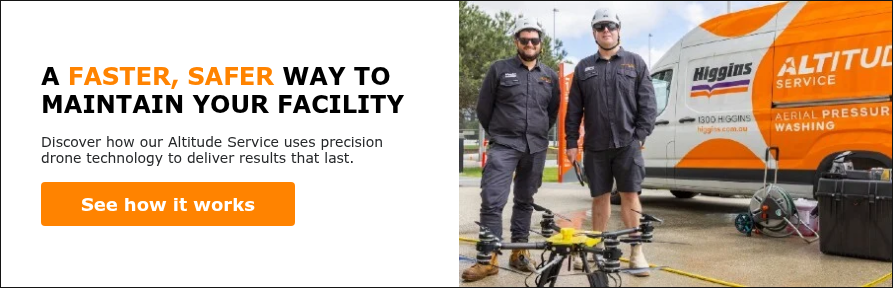
Higgins Coatings provides comprehensive building maintenance plans, commercial painting, and facade washing services across Australia. Our drone pressure washing service delivers superior cleaning results faster than traditional methods, with minimal disruption to building operations. With an ISO tri-certification in safety, quality, and the environment and almost 80 years of experience, Higgins understands what commercial property managers need. Contact us today to learn more about our building maintenance solutions.